

The evidence behind Fuel the Driver
Sleep and leadership.
A rough night can follow you into the meeting. What does the research actually show? Here are the numbers, the limits and a useful next step.
By Dai Manuel · Research checked 5 October 2026 · Educational information, not medical advice.
7+
hours regularly
Adult health consensus, ages 18 to 60. Not a ceiling.
9
study participants
The small lab study behind the presentation’s sleep finding.
20.1%
lower glucose disposal
Calculated from published means. Not 20% worse leadership.
01 / The laboratory finding
One short night. A measurable metabolic change.
Donga and colleagues studied the same nine healthy adults after two different sleep conditions. They then used an insulin clamp, a laboratory method for measuring the body’s response to insulin. This was a physiology experiment, not a leadership study.
Time allowed for sleep
Hours of sleep opportunity, zero baseline
| Condition | Value |
|---|---|
| Normal sleep opportunity | 8.5 h |
| Restricted sleep opportunity | 4 h |
Glucose disposal during the clamp
µmol per kg lean body mass per minute
| Condition | Value |
|---|---|
| After normal sleep opportunity | 40.7 |
| After restricted sleep opportunity | 32.5 |
Where “about 20%” comes from
(40.7 − 32.5) ÷ 40.7 × 100 = 20.1%. That is the relative fall in mean glucose disposal, reflecting peripheral insulin sensitivity.
The paper also reports an approximately 25% reduction in glucose infusion rate. That is a different measure. These percentages should not be swapped.
What this cannot tell us
Nine people and one restricted night cannot predict your personal response, diagnose diabetes or tell us how much worse a leader will perform. The study did not measure team productivity. No 20% productivity claim belongs here.
Read the original study abstract02 / The workplace evidence
Sleep quality matters to the people around you.
Barnes and colleagues followed leaders and their teams across working days. Poorer nightly leader sleep quality was associated with more daily abusive supervision, and that behaviour was linked to lower work-unit engagement. Sleep quantity did not show the same association in this study.
01 / ASSOCIATION
Poorer leader sleep quality
02 / ASSOCIATION
More daily abusive supervision
03 / ASSOCIATION
Lower work-unit engagement
Sleep is not an excuse for treating people badly. A leader is still responsible for how they respond, and an organisation is still responsible for manageable workloads.
Read Barnes et al., Academy of Management Journal, 2015Seven or more. Regularly.
The American Academy of Sleep Medicine and Sleep Research Society recommend seven or more hours of sleep per night on a regular basis for adults aged 18 to 60. This is a health consensus, not a guarantee of peak leadership performance.
Duration is only part of the picture. Quality, timing and regularity matter too. Some people need more than seven hours. Persistent insomnia, heavy snoring, gasping during sleep or excessive daytime sleepiness deserve a conversation with a qualified clinician.
Read the AASM and SRS consensus, 201503 / Put it to work
A seven-day leadership sleep audit.
This is a coaching experiment, not a treatment or another perfect streak. Use observations to check your instincts rather than assuming every difficult day is a sleep problem.
1
Notice the pattern
Record bedtime, wake time, estimated sleep and how rested you feel. Note workload and interruptions too. You are looking for a pattern, not scoring your worth.
2
Protect one boundary
Choose one realistic change, such as a clearer end to late-night email or a consistent sleep opportunity. Tell anyone affected. Do not take the time from someone else’s recovery.
3
Ask, then review
Notice patience and attention in meetings. Ask a trusted colleague what they observed. Review after a week without claiming your small experiment proves cause and effect.
04 / For coaches and team leads
Three ways to use this page with your people.
1
Share it before the conversation
Send this page to a client or your leadership team before a session. The charts and sources give everyone the same starting point, so the conversation can be about them, not about defending the science.
2
Run the audit as a team
Each person runs the seven-day audit privately. Compare patterns, not scores. The useful question is not who slept best. It is what the team notices about energy, patience and focus across a normal week.
3
Bring it into the room
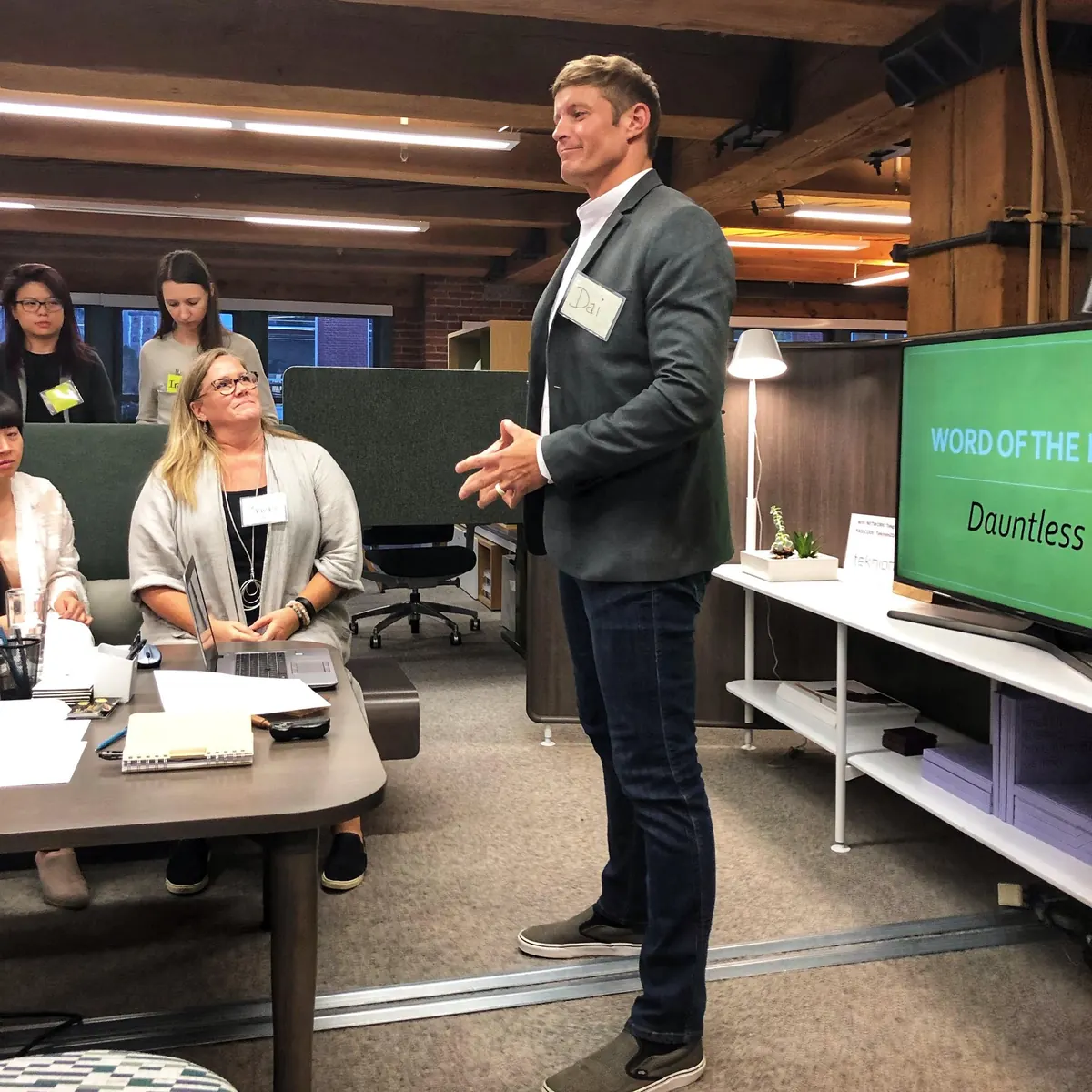
This research is part of Fuel the Driver, Dai’s 35-minute session for teams. The talk turns these findings into one practical Monday plan, with movement, honest conversation and a team ritual you choose together.
Next step
Bring the research to your team.
Dai speaks to leadership teams, clinics and conferences about sleep, energy and the person behind the role. Every talk is quoted after a short conversation about your audience, so tell us about your event and we will take it from there.
Questions
Sleep statistics, without the spin.
Does one short night really reduce insulin sensitivity by 20%?+
In Donga and colleagues' small laboratory study, mean glucose disposal during an insulin clamp fell from 40.7 to 32.5, approximately 20%. This reflects peripheral insulin sensitivity. It is not a forecast for every person, a measure of leadership performance or evidence that one short night causes diabetes.
Is sleep quality or sleep quantity more important for leaders?+
Both deserve attention. Barnes and colleagues found a daily association for leader sleep quality, not sleep quantity, in their study of supervision and team engagement. That does not make duration irrelevant. The adult sleep consensus recommends regularly getting at least seven hours.
How much sleep should an executive get?+
The AASM and Sleep Research Society consensus recommends seven or more hours regularly for adults aged 18 to 60. That is a general health recommendation, not an executive-specific prescription or a ceiling. Individual needs vary, and sleep quality, timing and regularity also matter.
Can a better sleep routine guarantee a better team?+
No. Team outcomes also depend on workload, trust, resources and how people are treated. Protecting sleep is one sensible part of the work. It does not excuse harmful behaviour or replace changes to a poorly designed workplace.
Sources and how to read the charts
The charts use published values with zero baselines. The 20.1% figure is our calculation from the reported means, not a separate trial result. No simulated people, invented outcomes or leadership percentage improvements are shown. This page summarises selected research; it is not a systematic review.
- Donga et al. (2010). A single night of partial sleep deprivation induces insulin resistance in multiple metabolic pathways in healthy subjects. Journal of Clinical Endocrinology & Metabolism, 95(6), 2963–2968.
- Barnes et al. (2015). You wouldn't like me when I'm sleepy: Leaders' sleep, daily abusive supervision, and work unit engagement. Academy of Management Journal.
- Watson et al. (2015). Recommended amount of sleep for a healthy adult: A joint consensus recommendation of the American Academy of Sleep Medicine and Sleep Research Society. Journal of Clinical Sleep Medicine.