

Business coaching guide · October 26, 2026
Business Coaching in Vancouver From Someone Who Has Run the Floor
By Dai Manuel · Updated October 26, 2026
Business coaching from an operator who grew Fitness Town from three to eight locations and co-owns CrossFit BC. What owners bring, how it differs from consulting, and who it is not for.
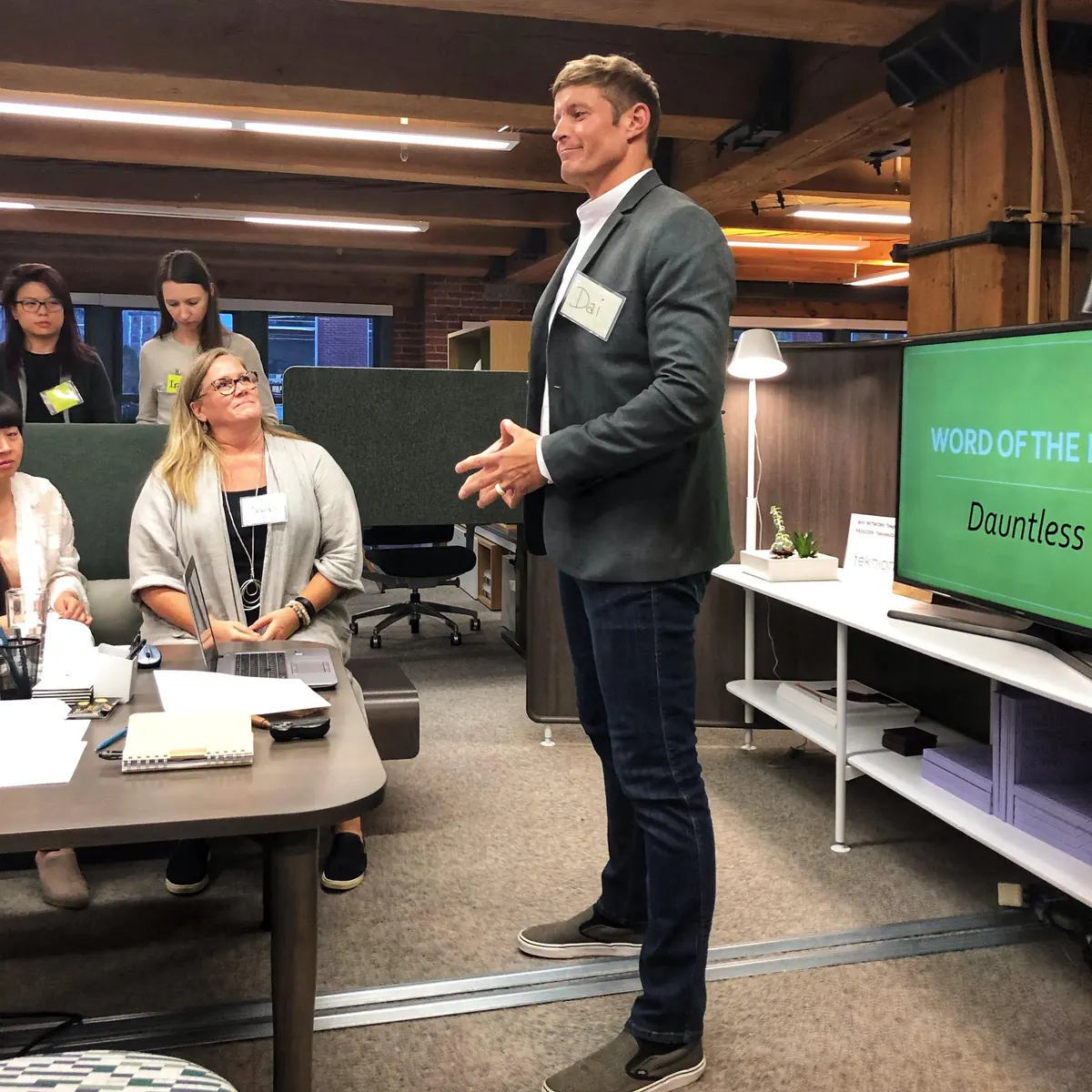
Business coaching from an operator means working one to one with someone who has carried a payroll, grown a multi-location business and run a gym day to day, and who helps you make better decisions inside your own business. I do this in person in Vancouver and online across Canada. I was COO of Fitness Town for years while it grew from three to eight locations, and today I co-own and run CrossFit BC in Olympic Village with my wife, Christie.
Key takeaways
Key takeaway
- Business coaching from an operator focuses on the decisions in front of you, using your numbers, with you doing the work. Dai treats the owner's health and the business as one system, because the same person runs both.
I have been coaching people professionally since 1995. For most of that time the work was about bodies. Now my focus is the person carrying the company, because for an owner the business and the body are tangled together: one keeps asking for more, and the other usually pays for it.
This page explains what business coaching with me is, what owners actually bring to it, why I refuse to separate your health from your business, and who should not hire me.
What is business coaching from an operator?
It is coaching from someone who has done the job, as opposed to someone who has studied it. That difference matters most on a Tuesday afternoon when a manager quits, a lease renewal lands and your accountant wants an answer on payroll.
An operator-coach has lived with the consequences of their own decisions. At Fitness Town I watched growth get ahead of the people running it. Leadership there tracked payroll as a percentage of revenue every week. At CrossFit BC, our coaches are on payroll and paid per class, and I run the business with my wife, which brings its own set of decisions. CrossFit BC has been in business since 2008. When Christie and I took it over in 2025, I built HYROX as a new coaching program and a second revenue stream, and we are now an official HYROX Training Club. It is my proof that a long-running business can still add something new.
None of that makes me right about your business. It means I ask the questions a person asks after paying for the wrong answer once.
In practice, operator coaching looks like this:
- We work on the decisions in front of you this month, using your numbers.
- You do the work between sessions. I hold you to it.
- I tell you what I see, including the parts about you.
- The goal is a business that needs less of you, run by a person who has more left at the end of the week.
How is business coaching different from consulting and therapy?
Owners often come in unsure which of the three they need. Here is how I separate them.
| Business coaching | Consulting | Therapy | |
|---|---|---|---|
| Main question | What will you decide and do, and what is getting in your way? | What is the right answer for this business? | What is happening inside you, and why? |
| Who does the work | You, with structure and accountability | Mostly the consultant | You, with a licensed clinician |
| Typical output | Decisions, habits, a changed calendar, a stronger team | A report, a plan, a system built for you | Insight, healing, coping skills |
| Time frame | Months, with regular sessions | A defined project | Varies by need |
| Focus | You as the leader, and the business through you | The business | Your mental health |
I do some consulting inside coaching. If you need a weekly scorecard built, I will help you build it. But the deal is that you own it at the end, because a system you did not build tends to stop working the week the consultant leaves.
Therapy is a different profession and I am not a therapist. If what comes up in our work belongs with a clinician, I will say so plainly. Seeing both a coach and a therapist is common, and they do different jobs.
What do owners actually bring to business coaching?
Share usually working 49+ hours a week in Canada, 2021
%
| Condition | Value |
|---|---|
| Self-employed | 26.4 |
| Employees | 5.3 |
The topics change by industry. The underlying problems barely change at all. Six come up again and again.
Growth that outruns the team
At Fitness Town, going from three locations to eight, the hardest lesson was that our growth outran our managers. The real estate, the equipment and the marketing could all move faster than people could grow into the job of running a location. Locations opened before their leaders were ready, and my rule since then is simple: do not open until someone can run it without you.
This is the most expensive problem on the list, and it is common because promotion usually rewards the wrong thing. A study of 53,035 sales workers at 214 firms found that doubling a new manager's pre-promotion sales corresponded to a 7.5% decline in the sales performance of each person they then managed. The best seller often becomes a weaker manager.
My advice before any second location, second team or second product line is to grow a leader first. I wrote a full piece on how to do that, with a readiness checklist: When growth outruns your managers.
The founder doing everything
Many owners are the bottleneck in their own business, and most of them know it. Every decision routes through them because they are fast, they care, and at some point it was true that nobody else could do it.
The trap is that the business shapes itself around you. Staff stop deciding because you will override them. Customers ask for you. The work you are best at gets pushed to evenings, because the day is full of work someone else could do.
Coaching here is unglamorous. We list what you did last week, sort it, and move one category of work off your plate at a time, with a person and a standard attached to it.
Hours
Long hours are normal for owners in this country. In Statistics Canada's 2021 data, 26.4% of self-employed people in their main job usually worked 49 or more hours a week, compared with 5.3% of employees.
I worked 60 to 70 hour weeks for years. I am not going to pretend those hours never got anything done. But the research on output is blunt. In Pencavel's analysis of First World War munitions workers, output rose in proportion to hours up to a threshold of around 49 hours a week and then flattened, and output at 70 hours differed little from output at 56. I go deeper on that in long working hours and productivity.
The useful move is to find out where your hours actually go before you try to cut them. I wrote a one-week method for that: Where a 60-hour week actually goes: a founder time audit.
The numbers that matter weekly
A lot of owners look at their numbers monthly, after the bookkeeper is done, which means every problem is at least four weeks old by the time they see it.
At Fitness Town, leadership tracked payroll as a percentage of revenue every week. A weekly ratio like that surfaces a problem while it is still small and cheap to fix.
Every business has a short list like that: three to six numbers that tell you whether this week was good, reviewed on the same day every week. For a service business it is usually some mix of revenue, labour cost as a share of revenue, new leads, conversion and retention.
Here is an example from my own gym that I am comfortable publishing. Over 12 months at CrossFit BC, 607 drop-ins became 94 leads, 37 clients and 10 paying members. The average time from drop-in to lead was 15.7 days. Laid out on one page like that, you can see exactly where people drop off.
Part of coaching is building your version of that page and then actually looking at it every week.
Running a business with your spouse
Christie and I co-own CrossFit BC. Working with your spouse can be the best part of owning a business and the part most likely to quietly wear both of you down, often in the same week.
The problems I see most are unclear roles, decisions that have no owner, and business conversations that leak into every room of the house. The fixes are structural: written roles, agreed decision rights, a set time for the business meeting, and an agreement about when the business is off the table.
I wrote about what I have learned in lessons from co-owning CrossFit BC. If you run a company with a partner at home, this is one of the most valuable things we can work on, and one of the least discussed.
Delegation
Delegation fails for two reasons: the owner hands off tasks without handing off authority, or the owner hands off to someone who was never set up to succeed.
Gallup estimates that managers account for at least 70% of the variance in employee engagement scores across business units. Gallup also found that companies fail to choose the candidate with the right talent for the manager job 82% of the time. Put those together and the risk is clear. When you delegate to a manager, the quality of that manager shapes the experience of everyone under them.
So we work on both sides. Your side: what you hand over, how you define good, how often you check, and how you stop taking it back. Their side: what your managers need from you to actually own the work.
Why do I treat your health and your business as one system?
Because they are run by the same person, on the same 24 hours, with the same nervous system.
When an owner sleeps badly for a month, the business gets a slower, shorter-tempered decision-maker. When the business has a bad quarter, the owner stops training, eats in the car and drinks a little more. The loop runs in both directions. Separating them into a business coach, a trainer and a "work on yourself someday" list is how owners end up fixing one while the other gets worse.
The Canadian data backs this up. In a 2023 BDC survey of 1,500 small business owners, 45% said they felt mental health challenges, up from 38% the year before, and 54% named work/life balance as a concern. In a Canadian Mental Health Association study supported by BDC, 62% of entrepreneurs said they feel depressed at least once a week, and 46% said mental health issues interfere with their ability to work. I cover more of that in entrepreneur mental health in Canada.
Physical risk follows the hours too. The WHO and ILO estimated that working 55 or more hours a week is associated with a 35% higher risk of stroke and a 17% higher risk of dying from ischemic heart disease, compared with working 35 to 40 hours.
This is coaching, not medical advice. If something health-related needs a doctor, I will send you to one.
What it means in practice is simple. Alongside the business work, we look at your sleep, your training and your hours with the same seriousness as your margins. The tool I use is the 2% Solution: 30 minutes a day, about 2% of your day, split into 15 minutes moving, 5 minutes still and 10 minutes reading or learning. It is small on purpose. Owners who are stretched do not need a second job called wellness. They need a floor they can hold during the worst week of the quarter.
If you want the health side in more depth, start with executive health and the signs of founder burnout.
How do you know if you need a business coach?
Many owners wait too long. They hire help after the second location is already struggling or after a health scare, when the options are narrower and more expensive.
These are the signals I would take seriously:
- You cannot take a full week off without the business slipping, and you have stopped trying.
- Your best people bring you decisions they could make themselves.
- You see your key numbers monthly, or only when something has already gone wrong.
- You are planning to grow, and you could not name the person who will run the new piece.
- Your training, sleep or family time is the first thing cut every time work gets busy.
- You and your business partner, or your spouse, keep having the same argument about the business.
One of these is normal. Three or more, sustained over a few months, usually means the business has outgrown the way you are running it. That is the point where an outside view pays for itself, because you are too close to see the pattern you are in.
What does working together look like?
It starts with a free 20-minute call. We talk about what is going on, I tell you honestly whether I think I can help, and if I cannot, I will usually point you to someone who can.
If we are a fit, private coaching runs like this:
- From $2,500 CAD a month, with a three-month minimum, plus applicable taxes.
- In person in Vancouver or online anywhere in Canada.
- Regular one-to-one sessions, with accountability between them.
- We start with your numbers, your calendar and your health baseline, then choose the one or two problems that matter most this quarter.
If you want to test the waters on a single problem first, a one-hour paid working session is $300. If you go ahead with private coaching, it is credited toward your first month.
The first few weeks are mostly about seeing clearly. You will log a week of your time, we will put your weekly numbers on one page, and we will take an honest look at your sleep, training and hours. It helps to see those three things side by side. After that, the work is narrower than people expect: one or two problems at a time, worked on until they are actually fixed.
I keep the practice deliberately small and take clients by application only. I would rather do excellent work with a handful of owners than average work with a crowd. You can read more about how I coach on the coaching page, and about where I come from on the about page.
Who is business coaching with me not for?
I would rather say this now than after your first invoice.
It is not for you if you want someone to run your business for you. I will help you build systems and make decisions, but you are the one who has to run them.
It is not for you if you want validation. I am warm, and I am also direct. If the problem is you, I will say so, kindly and clearly.
It is not for you if you want to keep the health conversation off the table. You can set the pace on that, but it will come up, because it is half of the work.
It is not for you if you need a licensed therapist, an accountant or a lawyer. I work alongside those people. I do not replace them.
And it is probably not for you if you are in a pure startup sprint, pre-revenue, looking for venture capital advice. My experience is in operating real businesses with real staff, real payroll and real customers walking through a door.
It is for owners and executives, mostly 40 and over, who are carrying a lot at work and at home, and who are ready to change how they run both.
Next step
If something on this page sounds like your week, book a free 20-minute call through the coaching page. Bring one problem. We will talk about it straight, and you will leave knowing whether working together makes sense.
Common questions
What is the difference between a business coach and a business consultant?
A consultant mostly does the work and hands you an answer or a system. A business coach helps you make and carry out the decisions yourself, with structure and accountability. Dai does some consulting inside coaching, such as building a weekly scorecard, but you own it at the end.
How much does business coaching with Dai cost?
Private coaching starts at $2,500 CAD a month with a three-month minimum, plus applicable taxes. A single one-hour paid working session is $300. Every engagement starts with a free 20-minute call.
Do you coach owners outside Vancouver?
Yes. Sessions run in person in Vancouver or online anywhere in Canada.
Is business coaching the same as therapy?
No. Therapy is a licensed clinical profession focused on your mental health. Coaching focuses on decisions, habits and leadership. If something belongs with a clinician, Dai will say so.
Why does a business coach care about my health?
Because the same person runs the business and the body. Poor sleep, no training and long hours show up in decisions. In a 2023 BDC survey of 1,500 owners, 45% reported mental health challenges. This is coaching, not medical advice.
Sources
- Promotions and the Peter Principle, Benson, Li and Shue, NBER Working Paper 24343, 2018 (Quarterly Journal of Economics, 2019)
- Quality of Employment in Canada: Long working hours, 1976 to 2021, Statistics Canada
- The Productivity of Working Hours, Pencavel, IZA Discussion Paper 8129, 2014
- Why Great Managers Are So Rare, Gallup
- Entrepreneurs' mental health has decreased significantly compared to last year, BDC, 2023
- Going it Alone: the mental health and well-being of entrepreneurs in Canada, CMHA with BDC
- Long working hours increasing deaths from heart disease and stroke, WHO and ILO, 2021
Next step
Talk it through with Dai
More in this guide
Coaching · October 26, 2026
Where a 60-Hour Week Actually Goes: A Founder Time Audit
Most founders cannot say where their hours really go. A one-week time audit with eight categories and a table template, plus what the research says about long hours and constant interruptions.
Coaching · October 26, 2026
When Growth Outruns Your Managers: Grow a Leader Before the Next Location
The hardest lesson from growing Fitness Town from three to eight locations: growth outran manager readiness. What the research says about promoting your best performer, and a leader-readiness checklist.