

Wellness keynote guide · October 11, 2026
Virtual vs In-Person Keynote: Cost, Attention and When to Choose
By Dai Manuel · Updated October 11, 2026
When a virtual keynote is the right call, when it is not, what it really saves you, and how to design a session a remote audience will actually stay for.
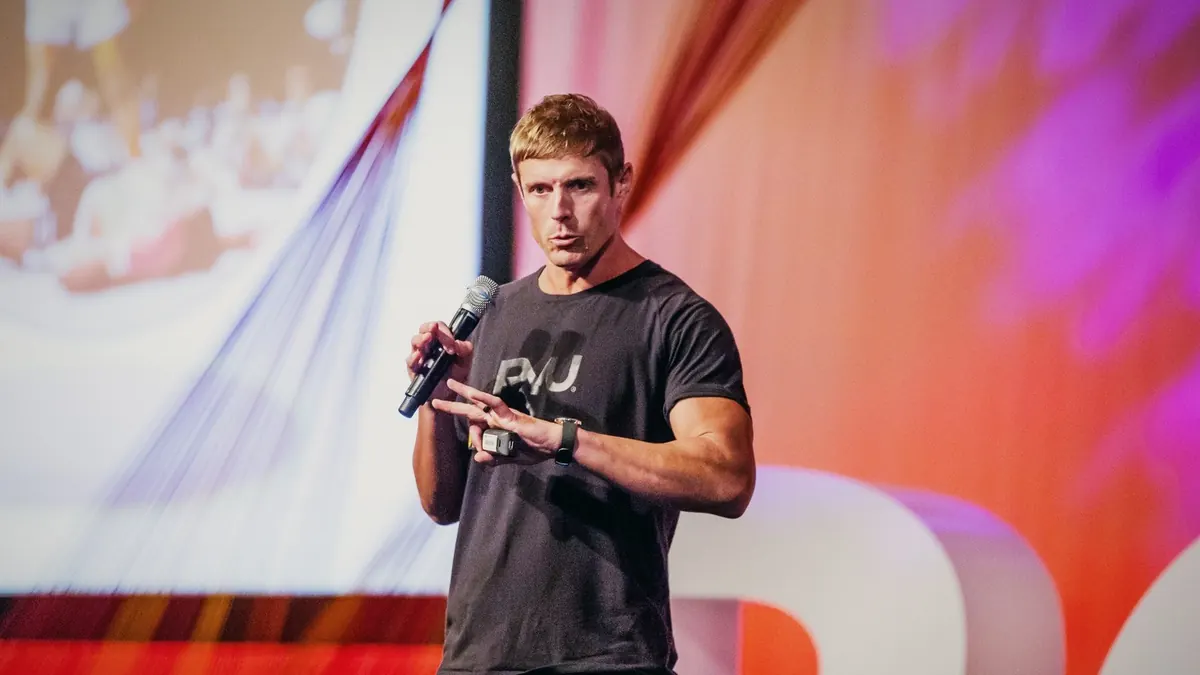
A virtual keynote is usually cheaper than an in-person one, but the saving is smaller than most planners expect and the attention cost is bigger. Book virtual when your people are spread out, the budget is tight or the goal is information. Book in person when the goal is behaviour change, team connection or a moment people will talk about the next day.
Key takeaways
Key takeaways
- Choose virtual for reach, frequency and tight budgets; choose in person when the goal is connection or behaviour change.
- Virtual saves on travel, venue and sometimes the fee, but the Speakers Bureau of Canada gives no fixed discount, so ask.
- Hybrid is often the most expensive format because you pay for the room and the broadcast.
- Research links back-to-back video calls and long video use to stress and fatigue, so keep virtual keynotes shorter and book them after a break.
- Design for attention: change mode every 8 to 10 minutes, hide self-view, end with a written action, follow up the same day.
- At hybrid events, assign a remote moderator or the online audience will be forgotten.
That is the short answer. The rest of this page covers the real cost lines, what the research says about attention on screen, how to design a session for a remote audience, the hybrid trap that catches most events, and a decision table you can take into your next planning meeting. If you are earlier in the process, start with the wellness keynote guide.
When does a virtual keynote work, and when does it not?
Virtual works well in four situations. Your team is distributed across provinces or countries and flying everyone in is not realistic. The session is part of a regular rhythm, like a monthly all-hands or a quarterly learning series, where the relationship already exists. The budget would only stretch to a lower-calibre speaker in person. Or the timing is short notice and travel cannot be booked in time.
Virtual struggles in others. If the point of the event is connection between colleagues, a screen works against you, because the people watching are not in a room with each other. If you want people to commit to a change in behaviour, such as sleep, movement or how they handle pressure, the evidence on attention below suggests you will lose some of them before you get to the ask. And if this is your one big event of the year, the energy of a live room is part of what you are paying for.
A useful test: ask what you want people to do differently the Monday after. If the answer is "know something", virtual is fine. If the answer is "act on something together", lean towards in person.
What does a virtual keynote really cost compared with in person?
Typical Canadian keynote fee ranges, before tax and travel (Speakers Bureau of Canada, 2026)
CA$ per session (low and high end of range)
| Condition | Value |
|---|---|
| Emerging (low) | 3500 |
| Emerging (high) | 7000 |
| Experienced (low) | 7500 |
| Experienced (high) | 20000 |
| High-demand (low) | 20000 |
| High-demand (high) | 50000 |
The speaker fee is only one line. The Speakers Bureau of Canada publishes typical ranges on its fees page (updated August 2026): emerging speakers at $3,500 to $7,000, experienced speakers at $7,500 to $20,000 and high-demand speakers at $20,000 to $50,000. Those fees exclude tax and travel. The same page lists virtual presentations and local events among the things that "often access reduced rates", but gives no figure for the discount, so treat any number you hear as a negotiation, not a rule.
The bureau also notes that organizations usually spend 10% to 30% of the total event budget on the speaker. That ratio is a useful sanity check. If the speaker is 60% of your budget, something else (production, follow-up, the room) is probably underfunded.
Here is how the cost lines usually move between formats. These are categories, not prices; get quotes for each.
| Cost line | In person | Virtual | Hybrid |
|---|---|---|---|
| Speaker fee | Full rate | Often reduced (bureau says "reduced rates", no set %) | Usually full rate, as the speaker is in the room |
| Travel, hotel, per diems | Yes, unless the speaker is local | None | Yes, unless local |
| Venue and catering | Yes | None, or a smaller watch-party space | Yes |
| AV in the room | Microphones, screen, confidence monitor | None | Room AV plus cameras and a stream feed |
| Streaming and production | Optional (recording) | Platform, producer, tech rehearsal | The biggest line: cameras, encoder, platform, producer, remote moderator |
| Staff time | Event day | Producer and chat moderator | Both teams, plus coordination |
| Attendee time and travel | Highest | Lowest | Mixed |
The surprise for most planners is hybrid. It is often the most expensive format because you pay for the room and the broadcast, and you need two production teams that talk to each other.
A local speaker narrows the gap between virtual and in person. If your event is in Vancouver and the speaker lives in Vancouver, the travel line disappears and in person often wins on value. For more on fee structures and what drives them locally, see how much a keynote speaker costs in Vancouver.
Why do virtual audiences lose attention?
Three bodies of research are worth knowing, and each comes with limits.
Microsoft's Human Factors Lab ran an EEG study in March 2021 with 14 participants. Each person sat through four half-hour video meetings back to back, and on another day the same four meetings with 10-minute breaks between them. Without breaks, brain activity associated with stress built up across the two hours. With breaks, it stayed level, and a marker associated with engagement stayed positive instead of shifting towards withdrawal. Fourteen people is a small sample, so read it as a signal, not proof. The practical point holds anyway: an audience that has been on calls all morning arrives at your keynote already loaded.
Jeremy Bailenson of Stanford published a widely cited 2021 paper in Technology, Mind, and Behavior proposing four reasons video calls are tiring: intense close-up eye gaze, the extra effort of sending and reading nonverbal cues, constantly seeing your own face, and being stuck in one spot to stay in frame. He is clear that these are arguments based on prior research that had not yet been directly tested on video calls.
His Stanford team then surveyed 9,787 people in an online convenience sample (published 2023 in Computers in Human Behavior Reports). People who used video calls more often and for longer, and who had fewer breaks between them, reported more fatigue. Women reported more fatigue than men, partly linked to anxiety about seeing their own image. This is a self-report survey, so it shows associations, not cause.
Put together: your virtual audience is probably tired before you start, and the format itself adds load. Design for that.
How do you design a virtual keynote people stay for?
What attendees experienced at their most recent in-person event (Bizzabo 2025, n=1,558 organizers and attendees)
% of attendees
| Condition | Value |
|---|---|
| Plenty of interactive sessions | 23 |
| Gamification elements | 27 |
| Abundant networking | 30 |
Shorter is the first lever. A 60-minute in-person keynote often works better as 35 to 45 minutes online, with the saved time spent on questions. If you cannot shorten it, book it after a break rather than at the end of a morning of calls, which is what the Microsoft data points towards.
Change the mode every 8 to 10 minutes. A poll, a question in the chat, a 60-second pair-share in breakout rooms, a moment where everyone writes something down. The point is to give people something to do with their hands and attention, not to fill the session with gimmicks.
Bizzabo's 2025 State of Events survey (1,558 B2B organizers and attendees, fielded November 2024) is a reminder that this is rare even in person: only 23% of attendees said their most recent in-person event had plenty of interactive sessions. If interaction is thin in the room, it is usually thinner online unless someone designs for it.
Tell people they can turn their own camera off or hide self-view. Bailenson's self-view argument suggests that seeing yourself is part of the load. The speaker needs to see faces, but the audience does not need to see themselves.
End with a written action. Ask every person to type or write one specific thing they will do in the next seven days. In a virtual session this is easy to collect in the chat or a form, and it gives you a measurement baseline (more on that below). It also turns a talk into a commitment.
Send the follow-up the same day. A short email with the one idea, the action prompt and a two-question pulse survey. Online audiences close the tab and move on fast; the follow-up is where the session keeps working.
Tech and production checklist for a virtual keynote
Most virtual keynotes that go badly fail on production, not content. Run through this list two weeks out.
- Platform locked and tested on the speaker's own machine and network, not just yours. Confirm whether it is a meeting (attendees can unmute) or a webinar (they cannot).
- A named producer who is not the host. Their only job is the run of show, slides, polls, breakouts and spotlighting.
- A chat moderator who surfaces questions to the speaker and answers logistics questions so the speaker does not have to.
- A tech rehearsal at least two days before, on the same platform, with the producer, using the real slides and polls.
- Speaker setup: wired internet where possible, an external microphone, a camera at eye level and light in front, not behind.
- Backup plan: speaker's phone number, a dial-in, and slides held by the producer so they can share if the speaker's connection drops.
- Polls and breakouts built in advance, not on the fly.
- Recording rights agreed in writing. Recording is often priced separately, so confirm before the day.
- Captions turned on. Most platforms offer them, and they help people in noisy spaces and those for whom English is not a first language.
- Start time buffer: open the room 10 minutes early with music or a holding slide so the first minutes are not lost to people joining.
Most of these items belong in the speaker brief too. See what to put in a speaker brief for the full template.
What goes wrong at hybrid events?
The remote audience gets forgotten. It happens at almost every hybrid event that does not plan against it. The speaker plays to the energy in the room, questions come from the people with a microphone in front of them, and the people at home watch a wide shot of a stage and drift off.
Hybrid is not going away. Bizzabo's 2022 survey of event organizers found 68% planned a virtual component at their next onsite event. So it is worth designing for properly.
What I recommend:
- Assign a remote audience champion in the room, someone whose job is to bring chat questions to the stage and say them out loud.
- Alternate questions between the room and the stream, and say which is which.
- Give the speaker a confidence monitor showing the chat or a remote moderator, so they can address the online audience by name.
- Make every interaction work in both places. A show of hands in the room leaves remote people out; a poll on phones works for everyone.
- Put a camera on the speaker's face, not only a wide shot of the stage. Remote viewers need to see expression.
- Check the audio on the stream, not just in the room. Room microphones that sound fine live can be thin or echoey online.
If you cannot staff those roles, consider two separate sessions instead: an in-person keynote and a shorter virtual version for remote staff on another day. It can cost less than running a full hybrid broadcast badly.
How do you measure whether a virtual keynote worked?
Pick measures before the event, not after. For a virtual or hybrid session you get more data for free, so use it.
- Attendance against registration. Bizzabo's 2025 survey found the most common in-person registration-to-attendance rate reported by organizers was 20% to 40%, and 26% of organizers put webinar conversion at 30% to 40%. Compare your number with your own past events rather than chasing a benchmark.
- Drop-off curve. Most platforms show how many people were connected minute by minute. A sharp drop at a specific point tells you where the session lost people.
- Participation rate. What share answered at least one poll or posted in the chat.
- Written actions. The share of attendees who submitted their one action at the end.
- A seven-day pulse. Two questions: did you do the thing you wrote down, and what got in the way.
- A 30-day check on the business measure the session was meant to move, if there is one.
For wellness sessions specifically, tie the keynote to a measure HR already tracks, such as program uptake or EAP use. The workplace mental health business case walks through which measures hold up in a budget meeting.
Decision table: virtual, in person or hybrid?
| Your situation | Best fit | Why |
|---|---|---|
| Team spread across Canada or beyond, regular learning series | Virtual | Reach and frequency matter more than one big moment |
| Annual conference or kickoff, goal is energy and connection | In person | The room is part of the outcome |
| Goal is behaviour change (sleep, movement, stress) | In person, or virtual with strong follow-up | Attention and commitment are harder online, so design for them |
| Tight budget, distant speaker | Virtual | Travel and venue lines disappear and fees can come down |
| Local speaker, local audience | In person | The travel saving from virtual mostly vanishes |
| Most people in one room, a minority remote | Hybrid, only with a remote moderator and producer | Without those roles the remote audience gets forgotten |
| Short notice, under three weeks | Virtual | Travel and venue are hard to book in time |
| Leadership offsite, small group | In person | Small rooms reward conversation, not broadcast |
Do I offer virtual keynotes?
Yes. Alongside in-person keynotes, half-day workshops and emceeing, I offer virtual keynotes. I would rather help you pick the right format than sell you one, so if in person is the better fit for your goal, I will say so.
If you are weighing formats for an upcoming event, send me the date, the audience and what you want people to do differently afterwards, and I will come back with a recommendation and a quote.
Common questions
Is a virtual keynote cheaper than an in-person keynote?
Usually, but not always by as much as people expect. You avoid travel, accommodation, venue and catering, and the Speakers Bureau of Canada lists virtual delivery among the factors that often bring reduced rates. It gives no standard discount, though. You still pay for a platform, a producer and a rehearsal, and if the speaker is local the travel saving largely disappears.
How long should a virtual keynote be?
Shorter than in person. A 60-minute stage keynote often works better as 35 to 45 minutes online plus questions. Research from Microsoft and Stanford links long stretches of video calls, and fewer breaks between them, with more stress and fatigue. If the audience has been on calls all morning, schedule the keynote after a break rather than at the end of a block.
What makes a good hybrid event speaker?
One who speaks to both audiences on purpose. Look for a speaker comfortable addressing the camera as well as the room, who takes questions from the chat by name and uses interactions that work for remote people, such as phone polls instead of a show of hands. The organizer's side matters as much: a remote moderator and a producer are what make it work.
Can a virtual wellness keynote change behaviour?
It can, but it needs more design than an in-person talk. Keep it shorter, ask every attendee to write down one specific action for the next seven days, and send a follow-up the same day with a short pulse survey. Without the written action and follow-up, most of the effect fades when people close the tab.
What should I measure after a virtual keynote?
Attendance against registration, the minute-by-minute drop-off curve, the share who took part in at least one poll or chat, and the share who submitted a written action. Then send a seven-day pulse asking whether people did their action. If the session was tied to a business goal, check that measure at 30 days.
Sources
- Speaker Fees of Professional Speakers, Speakers Bureau of Canada, 2026
- Research Proves Your Brain Needs Breaks, Microsoft WorkLab Work Trend Index, 2021
- Nonverbal Overload: A Theoretical Argument for the Causes of Zoom Fatigue, Bailenson, Technology, Mind, and Behavior, 2021
- Video-conferencing usage dynamics and nonverbal mechanisms exacerbate Zoom Fatigue, particularly for women, Fauville et al., Computers in Human Behavior Reports, 2023
- State of Events and Industry Benchmarks 2025, Bizzabo, 2025
- Survey on the state of in-person events, Bizzabo, 2022
Next step