
Executive health guide · October 5, 2026
Digital overload: why always on is not a leadership strategy
By Dai Manuel · Updated October 5, 2026
A practical digital reset for leaders whose attention, sleep and decision-making are being crowded out by an always-on workday.
A full calendar does not always mean you are doing the work that matters.
Key takeaways
Run a one-week digital reset
- Audit one ordinary day: interruptions, reasons and energy.
- Remove two avoidable triggers before adding new habits.
- Protect sleep, one focused work block and a recovery break.
- Review the pattern after a week, not after one perfect day.
You can answer messages all morning, sit through six calls, check three dashboards and still reach the end of the day with the important decision untouched. That is not laziness. It is what happens when your attention is broken into pieces before you have a chance to use it properly.
For founders, executives and team leaders, the usual advice to use screens less is not especially useful. The screens are where the work lives. Email is the front door. Messages keep the team moving. AI tools are becoming part of the workflow. The answer is not to disappear for a weekend and hope Monday feels different.
The better question is this: how do you build a working day that uses digital tools without letting them run your nervous system?
Start with the cost, not the cure
Digital overload tends to arrive quietly.
Your best thinking moves later into the evening because the day is too fragmented. You check a message during dinner because it will only take a minute. You open your phone without knowing why. Sleep gets thinner. Small decisions take longer. By Friday, you are tired but cannot point to one thing that made you tired.
Frequent interruption carries a real cost. Research on workplace interruptions has found that people often compensate by working faster, but report more stress, frustration and time pressure in the process. Returning to demanding work also takes more effort than the interruption itself suggests.
That matters for leaders because your attention is not only personal. It shapes the room. When you respond to every message immediately, your team learns that everything is urgent. When you bring half your attention to a conversation, other people feel it. When you work late every night, your behaviour becomes a quiet policy even if your words say otherwise.
Before trying to fix anything, make the cost visible.
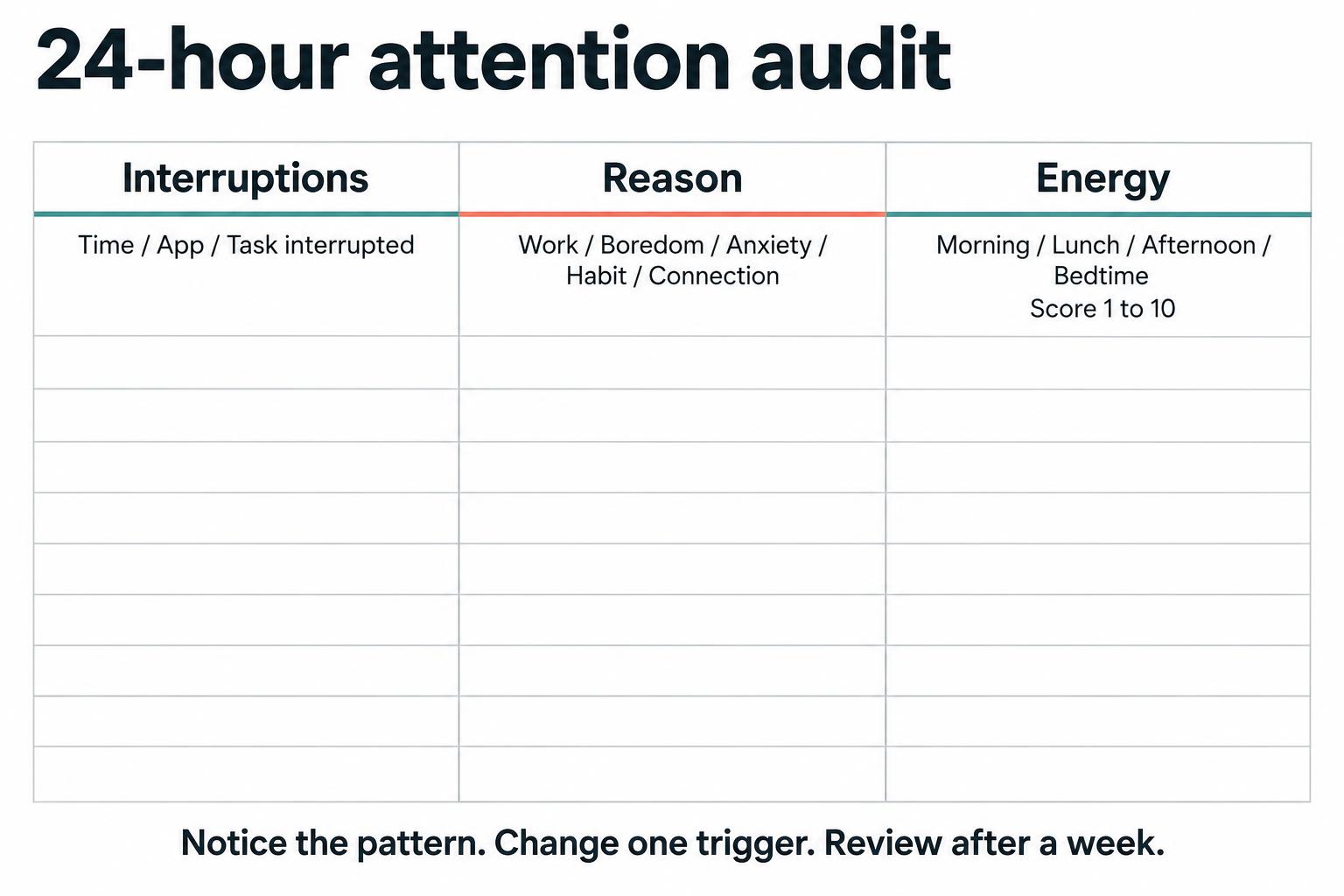
Run a 24-hour attention audit
Do not start with a detox. Start with evidence.
Pick one ordinary working day. Not a holiday. Not a day designed to make you look good. Track three things.
1. Pickups and interruptions. Look at your phone's built-in screen-time report. Record how often you picked it up and which five apps used the most time. During the day, make a simple mark each time a notification, message or impulse pulls you away from focused work.
2. The reason you reached. Use five labels: work, boredom, anxiety, habit or connection. Do not judge the reason. Just name it.
3. Your energy. Give your energy and mood a score from one to ten when you wake, after lunch, late in the afternoon and before bed.
At the end of the day, ask three questions:
What surprised me?
When did my attention fall apart?
Which two triggers showed up most often?
This is not a report card. It is a map. If you treat the numbers as proof that you have failed, you will reach for an extreme fix. If you treat them as information, you can change the part of the day that is actually causing trouble.
Reduce the triggers before adding new habits
Many people respond to a tired mind by adding more. A new morning routine. Another wellness app. A longer task list. More rules to fail at.
Start by removing avoidable friction instead.
Turn off non-essential notifications. Keep calls and messages that genuinely need a real-time response. Batch the rest. Research on disabling notifications is mixed, so this is not a guaranteed cure. It is still a sensible, low-risk experiment. Run it for one week and measure the result for yourself.
Move feeds out of reach. Take social and news apps off the first screen of your phone. Remove news widgets from the lock screen. Keep one chosen window for catching up rather than grazing all day.
Define the purpose before opening the tool. Before opening email, LinkedIn or an AI assistant, finish this sentence: I am here to ____. If you cannot name the job, close it.
That last point matters more as AI tools become normal at work. Anxiety about being replaced or left behind is real, but it does not need a made-up diagnosis. It needs an honest conversation about what the tool should handle and what still requires your judgment, relationships, taste and responsibility.
Write one line for your own use. For example: AI can help me organize information, but I make the final decision and own the consequences.
A clear boundary is easier to keep than a vague intention to use technology better.
Protect three anchors
Reducing noise creates space. You still need to decide what holds that space.
Three anchors are enough to begin.
A sleep anchor. Keep the phone out of the bedroom if you can. Choose a consistent point when work communication ends. The reason to take sleep seriously is broader than screens. A meta-analysis of 70 articles on short-term total sleep deprivation found a large effect on lapses in simple attention (g = -0.776). That concerns complete sleep loss, not one late email or an ordinary short night, so it cannot tell you the exact benefit of moving your phone. You do not need a perfect evening routine. You need a clear end to the working day.
A focus anchor. Protect one block before lunch for work that needs judgment rather than reaction. Put the phone elsewhere. Silence messages. Name the output before you begin. Not “work on strategy.” Write “make the decision and draft the first page.” On a hard day, shorten the block rather than cancelling it.
A recovery anchor. Give the afternoon a short downshift before you reach for more coffee or another feed. A few minutes of slow, comfortable breathing is one reasonable option. A 2023 meta-analysis pooled 12 randomised trials with 785 adults for its stress outcome. Breathwork showed a small-to-medium reduction in self-reported stress compared with controls (Hedges’ g = -0.35). Most studies had moderate risk of bias, and the techniques varied. This does not prove that a particular five-minute routine treats anxiety or burnout. Stop if uncomfortable; it is a tool, not a cure. A short walk without your phone can do useful work too.
The point is not to build an impressive routine. It is to create a day that still works when the week does not.
Make the reset visible to your team
Leaders often treat attention as a private discipline. It is also part of team design.
Tell people when you are available and when you are doing focused work. Decide which channel is for a real emergency. Stop rewarding every quick response as if speed and value are the same thing. Ask whether recurring meetings still need to exist. Protect other people's focus with the same seriousness you want for your own.
Then run a ten-minute check once a week:
What helped my sleep?
When did I do my best thinking?
Which trigger returned?
What one boundary will I protect next week?
Small corrections made every week beat a dramatic reset that disappears by Thursday.
Evidence, experience and the next small test
Research can guide a decision without making it for you. Your own experience matters too, especially when you recognise a familiar pattern and have had honest feedback about what happened next.
Kahneman and Klein’s review of skilled intuition identifies two important conditions: an environment with sufficiently predictable patterns, and enough opportunity to learn those patterns through feedback. Confidence alone is not a test of accuracy. Years of doing are useful when they include years of checking.
If a routine feels wrong, notice the signal. Ask what you observed, what else could explain it and what evidence would change your mind. Choose a low-risk adjustment, such as moving one meeting or batching non-urgent messages. Review the result a week later. In an unfamiliar or high-stakes situation, seek another perspective rather than treating a strong feeling as proof.
This is not about becoming anti-technology
Digital tools are useful. AI can remove dull work. Messages can keep distributed teams connected. Social platforms can create real opportunities. The goal is not less technology at any cost.
The goal is to use these tools on purpose.
If your attention has been scattered for months, begin with one ordinary day of honest observation. Reduce the two triggers that do the most damage. Protect sleep, one block of focused work and one short recovery practice. Then check the system each week.
If persistent anxiety, depression or sleep problems are affecting daily life, speak with a qualified health professional. A better workday can help, but it is not a substitute for clinical care.
For leaders who want help turning these ideas into a routine that fits their actual responsibilities, read about executive health coaching. You may also find resilience for leaders under pressure useful.
Research behind the practical advice
Digital overload and leadership: answers to common questions
Common questions
Do I need to stop using digital tools?
No. Start by noticing which tools serve a clear purpose and which interruptions can wait. Test small changes against your actual responsibilities.
When should I trust my instinct about a working routine?
Treat it as a useful signal when it comes from familiar patterns and honest feedback. Check the evidence, try a low-risk change and review the result. Confidence alone does not establish accuracy.
Can a digital reset replace mental health care?
No. Persistent anxiety, depression or sleep problems that affect daily life deserve assessment by a qualified health professional. Coaching and work-design changes are not substitutes for clinical care.
Next step